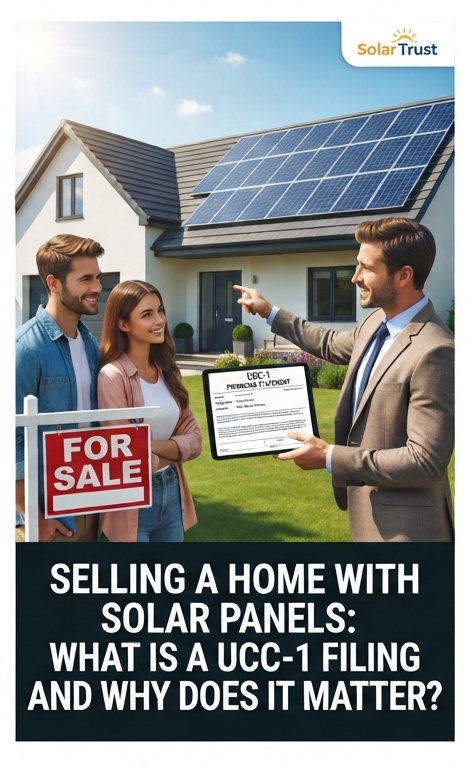
Selling a Home With Solar Panels: What Is a UCC-1 Filing and Why Does It Matter?
Many homeowners do not think about the solar agreement when they first decide to sell. The issue often appears later, when a title company or closing agent reviews the property’s records and discovers a UCC-1 fixture filing connected to the solar equipment.
At that point, a homeowner may suddenly hear questions about the solar financing, the equipment, the lender, and whether the filing needs to be released before the transaction can close.
So what exactly is a UCC-1 filing?
And does a UCC-1 filing mean that the solar company has a lien on your entire house?
The answer is more specific than many homeowners realize.
What Is a UCC-1 Financing Statement?
A UCC-1 financing statement is generally used to give public notice that a creditor may have a security interest in certain collateral.
In the residential solar context, a filing can be associated with the solar equipment installed at a property.
A fixture filing can appear in county real property records, which means it may become visible during a title search.
This is one reason a solar-related filing can become important when you are selling or refinancing your home.
Solar Cancellation HQ explains that the security interest associated with a solar fixture filing concerns the solar equipment rather than automatically becoming a mortgage on the homeowner’s house. However, because the filing can appear in property records, a title company may require the issue to be resolved before a sale or refinance can close.
Why Do Homeowners Often Discover It During a Sale?
A homeowner can live with solar panels for years without ever thinking about a UCC-1 filing.
The problem may only become visible when the property is being sold.
During a real estate transaction, the buyer’s title company or closing agent typically performs searches to identify recorded interests or other issues affecting the transaction.
If a solar-related filing appears, the closing team may ask questions such as:
- Who is the secured party?
- Is the solar equipment financed?
- Is the system leased?
- Is there a power purchase agreement?
- Has the loan been paid off?
- Does the lender need to release the filing?
- Can the solar agreement be transferred to the buyer?
- Is the buyer willing and able to assume the agreement?
- Does the title company require documentation before closing?
The answers can depend on the exact solar contract.
A UCC-1 Is Not the Same as a Traditional Mortgage
This distinction is important.
Homeowners sometimes see the word “lien” and immediately assume that the solar company has placed a mortgage against the entire property.
That is not necessarily what a solar fixture filing means.
Solar Cancellation HQ describes the security interest as being connected to the solar equipment, while also noting that the filing may appear in county real property records and become a title issue during a sale or refinance.
The practical takeaway is that homeowners should not ignore the filing simply because it is associated with equipment.
If a title company has identified the filing, address it early.
Do Not Wait Until the Closing Date
One of the worst times to discover a solar-related title issue is immediately before closing.
Imagine that you have:
- Accepted an offer.
- Completed inspections.
- Scheduled your move.
- Purchased another home.
- Made travel arrangements.
- Set a closing date.
Then the title company discovers a solar filing.
If documentation is needed from the solar lender or another party, obtaining and processing that paperwork may take time.
This is why homeowners who are considering selling should investigate their solar agreement before listing the property whenever possible.
How Can You Check for a UCC-1 Filing?
You may be able to investigate the records yourself.
Solar Cancellation HQ recommends checking your county recorder or clerk’s records using your name and property address and also checking the applicable state’s Secretary of State UCC database.
If you locate a filing, record the relevant details, including:
- The secured party’s name.
- Filing number.
- Filing date.
- Debtor name.
- Property information, if included.
- Any related solar financing information.
Keep a copy of the filing.
You can then provide the information to your real estate agent, title company, closing attorney, or other appropriate professional.
What If You Have a Solar Loan?
If the panels were financed through a solar loan, the lender may have a security interest connected to the equipment.
The loan does not necessarily disappear because you are selling the house.
Depending on the contract, several possibilities may need to be considered.
The loan may need to be paid off.
The buyer may potentially assume an agreement if the contract allows it and the relevant parties approve the transfer.
The solar company or lender may need to provide documentation.
The title company may require a release or other evidence before closing.
The exact process depends on the agreement and the parties involved.
What If You Lease the Solar Panels?
A solar lease is different from a solar loan.
With a lease, the homeowner generally does not own the equipment in the same way as someone who purchased the system outright.
That can create additional considerations during a home sale.
The buyer may need to qualify for or accept the lease according to the lease terms, or the existing agreement may need to be handled another way.
The first step is to find the actual contract.
Do not rely solely on what the salesperson told you several years ago.
Look at the written agreement and identify:
- The contract length.
- Transfer provisions.
- Buyout provisions.
- Early termination provisions.
- Maintenance responsibilities.
- Payment requirements.
- Equipment ownership.
- Requirements for selling the property.
What About a Power Purchase Agreement?
A power purchase agreement, or PPA, is another type of solar arrangement.
Instead of simply paying for a system through a traditional loan, the homeowner may agree to purchase electricity generated by the solar system according to the terms of the PPA.
PPAs can have long contract terms and may include provisions affecting a future home sale.
Again, the specific contract matters.
A homeowner should identify whether the agreement is a loan, lease, PPA, or another type of financing or ownership arrangement before assuming what must happen at closing.
What Information Should You Give the Title Company?
If you are selling a home with solar panels, provide the title company with the solar information as early as possible.
Useful documents can include:
- Solar purchase agreement.
- Solar loan agreement.
- Lease agreement.
- PPA.
- UCC-1 filing.
- Loan payoff information.
- Solar company contact information.
- Finance company contact information.
- Installation records.
- Warranty documents.
- Any previous release documents.
Giving these documents to the closing professionals early can help identify potential issues before they become urgent.
What If the Solar Company No Longer Exists?
This can make the situation more complicated.
A homeowner may have an old solar agreement with a company that no longer operates.
However, the financing may still be held or serviced by another company.
The UCC-1 filing may also remain visible in public records.
The fact that the original installer disappeared does not necessarily mean the filing automatically disappears.
You may need to determine who currently holds the relevant interest and what documentation is required to address it.
This is one reason keeping old solar paperwork is important.
Can a Solar Filing Prevent a Home Sale?
A UCC-1 fixture filing does not necessarily mean that you cannot sell your house.
However, it can create a title issue that must be addressed.
Solar Cancellation HQ notes that a title search can identify a fixture filing and that a closing agent may require the matter to be resolved before a sale or refinance can close.
The practical lesson is simple:
If you are selling a home with solar panels, investigate the solar paperwork early.
Do not wait until the final week before closing.
What If You Believe the Solar Agreement Was Improper?
Sometimes a homeowner discovers a UCC-1 filing while also believing that the original solar agreement involved misleading sales practices, unexpected financing terms, or other problems.
These are separate questions that may need to be evaluated together.
For example, you may need to determine:
- What agreement did you actually sign?
- Who sold the system?
- Who financed it?
- What representations were made?
- What does the contract say?
- Was the cancellation notice properly provided?
- Does the financing agreement contain the FTC Holder Rule notice?
- Was a UCC-1 filing recorded?
- What state law applies?
- What documentation supports your concerns?
A qualified attorney can review those issues based on the actual documents.
What Should You Do Before Listing Your Home?
If you have solar panels and plan to sell your home, consider taking these steps early:
1. Find Your Solar Agreement
Locate the original purchase, lease, loan, or PPA documents.
2. Identify the Financing Company
Do not assume the installer is the company that currently owns or services your financial obligation.
3. Check for a UCC-1 Filing
Search the appropriate property and UCC records.
4. Contact the Title Company Early
Tell them the property has solar and provide the relevant documents.
5. Ask About Payoff or Transfer Requirements
Find out whether the agreement can be transferred or whether another process is required.
6. Keep Copies of Everything
Maintain copies of payoff statements, releases, correspondence, and closing documentation.
Final Thoughts
Solar panels can provide significant benefits to homeowners, but solar agreements can also create paperwork that matters when a property is sold or refinanced.
A UCC-1 fixture filing should not automatically be confused with a mortgage on the entire home. However, because a fixture filing can appear in property records and become part of a title search, it is an issue worth investigating early.
If you are preparing to sell a home with solar panels, locate your agreement, identify your lender or solar provider, check for recorded filings, and provide the information to your title or closing professionals as early as possible.
If you also believe there were problems with the original solar transaction, gather your sales documents, financing paperwork, communications, and filing information so they can be reviewed by an appropriate professional.
Disclaimer: This article is for general informational purposes only and is not legal advice. UCC filings, solar financing agreements, leases, PPAs, and real estate transactions are governed by specific documents and applicable laws. Requirements vary by state and situation. A UCC-1 filing does not automatically mean that a homeowner has a mortgage against the entire property, and no particular legal outcome is guaranteed.